Privileged accounts, such as root, database owners, domain administrators
and service accounts, can do anything on the systems they belong to. Anchor
puts them under one authority. It knows every one of them, keeps their
passwords encrypted, verifies and changes them on the schedule you set, and
opens sessions for the people allowed to use them. Everything it does is
recorded as evidence.
Five views from a running installation: every account at a glance, a live
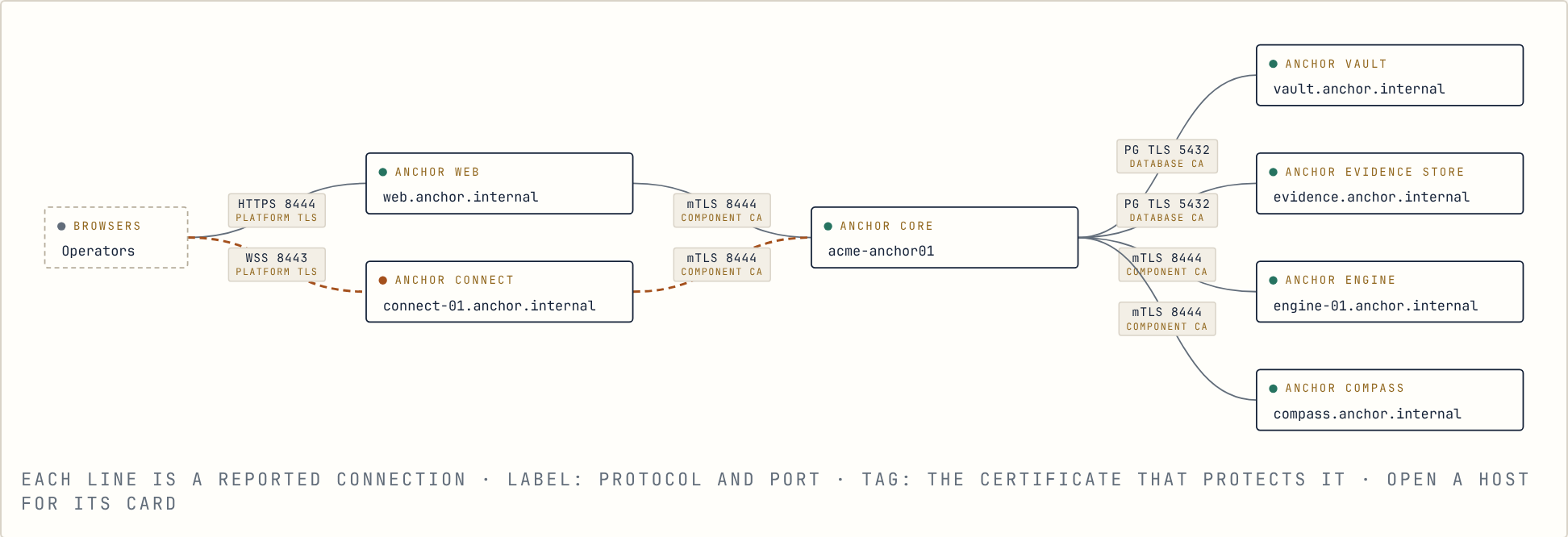
session, the posture score, the access map, and the deployment as the services
report it.
Live accounts
Every privileged account, by the server it lives on
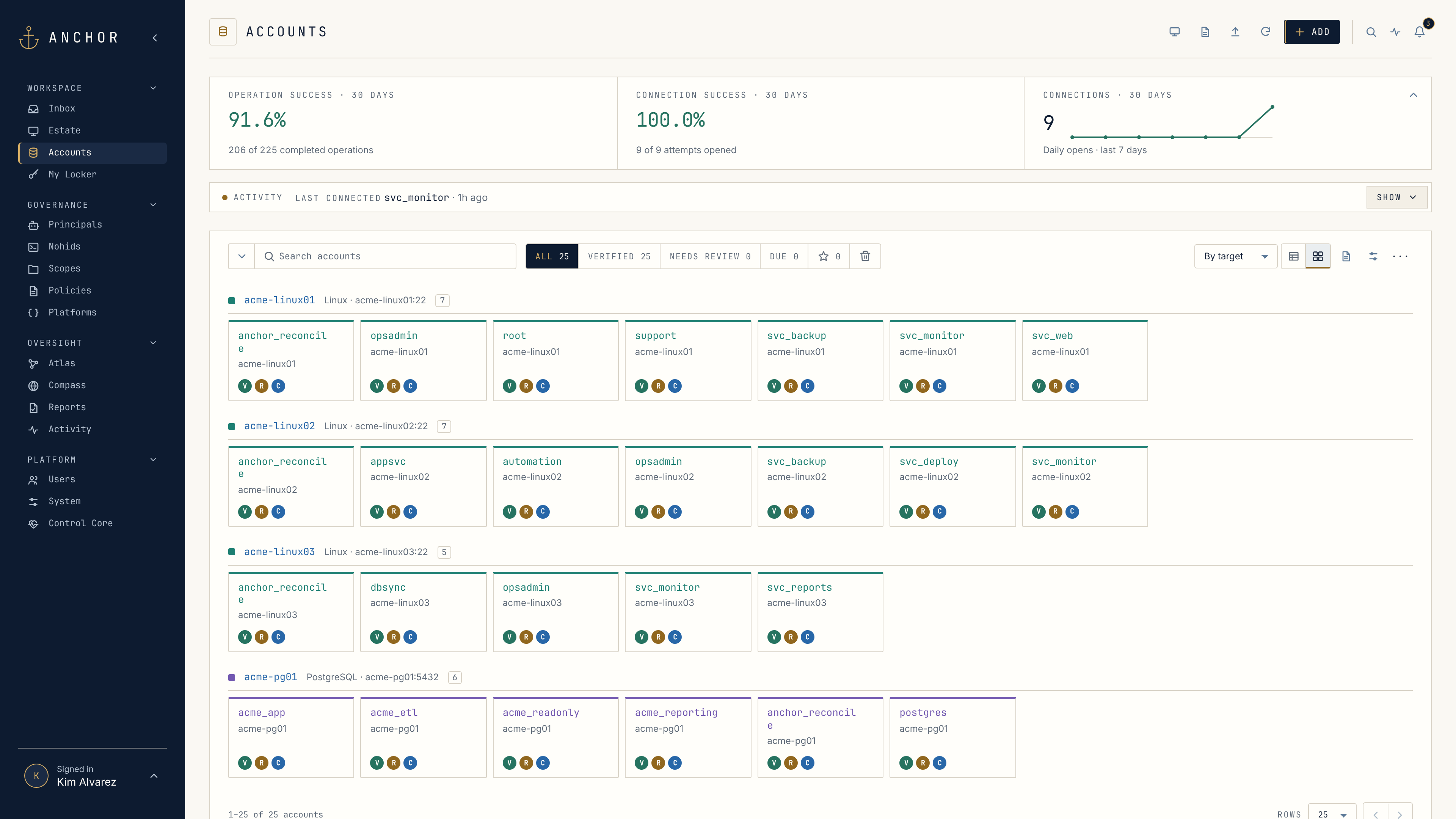
Accounts as cards, grouped by target. Each card shows the account's latest proof, its rotation and whether it can connect, so the whole estate reads at a glance.
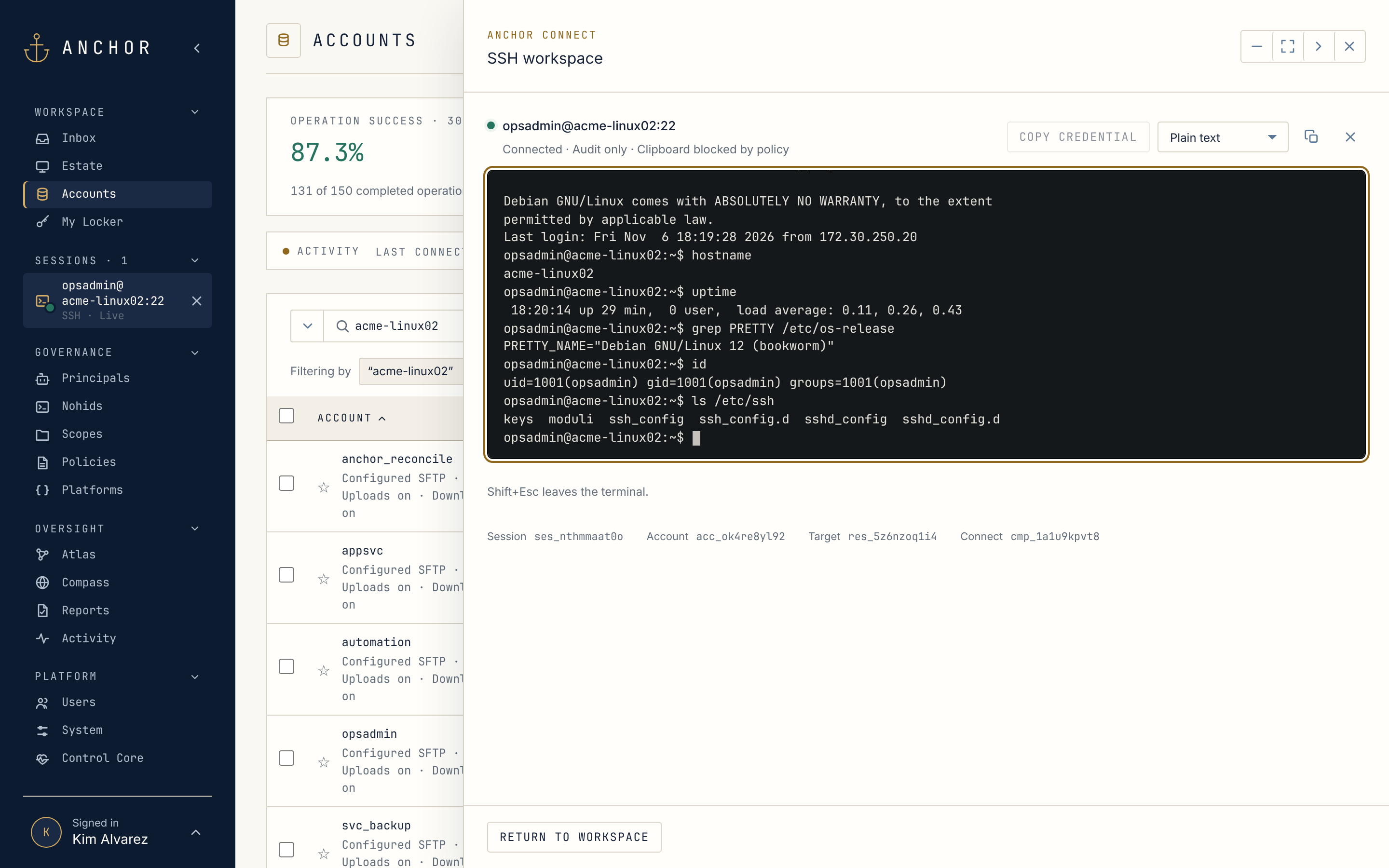
Anchor checked the person, the Policy and the server's identity, then opened the session with the stored credential. The person works; the password never left Anchor.
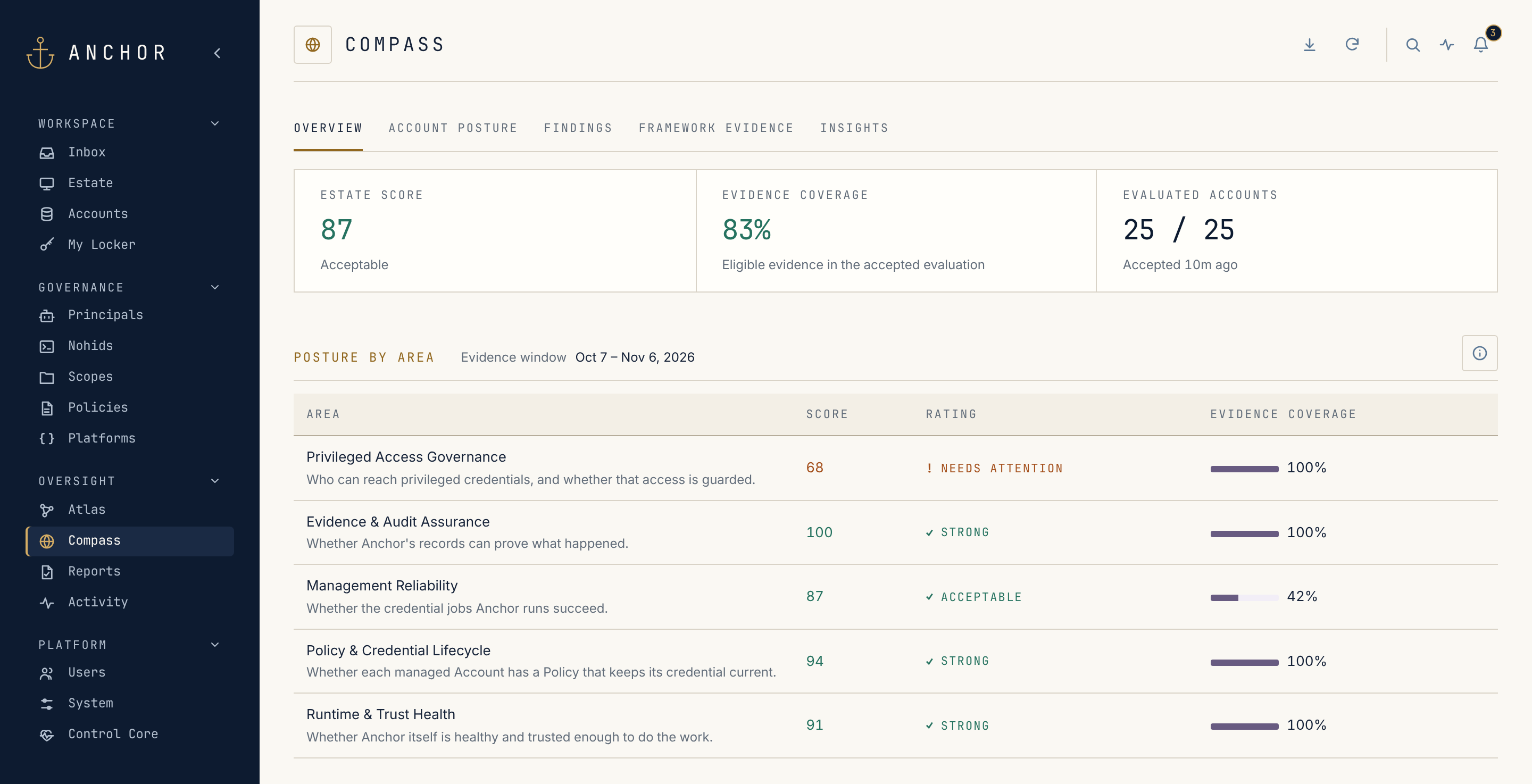
Compass scores the estate and every account from Anchor's own records, and maps the result to SOC 2, NIST SP 800-53 and NIST CSF 2.0 controls. Missing evidence stays visible instead of counting as a pass.
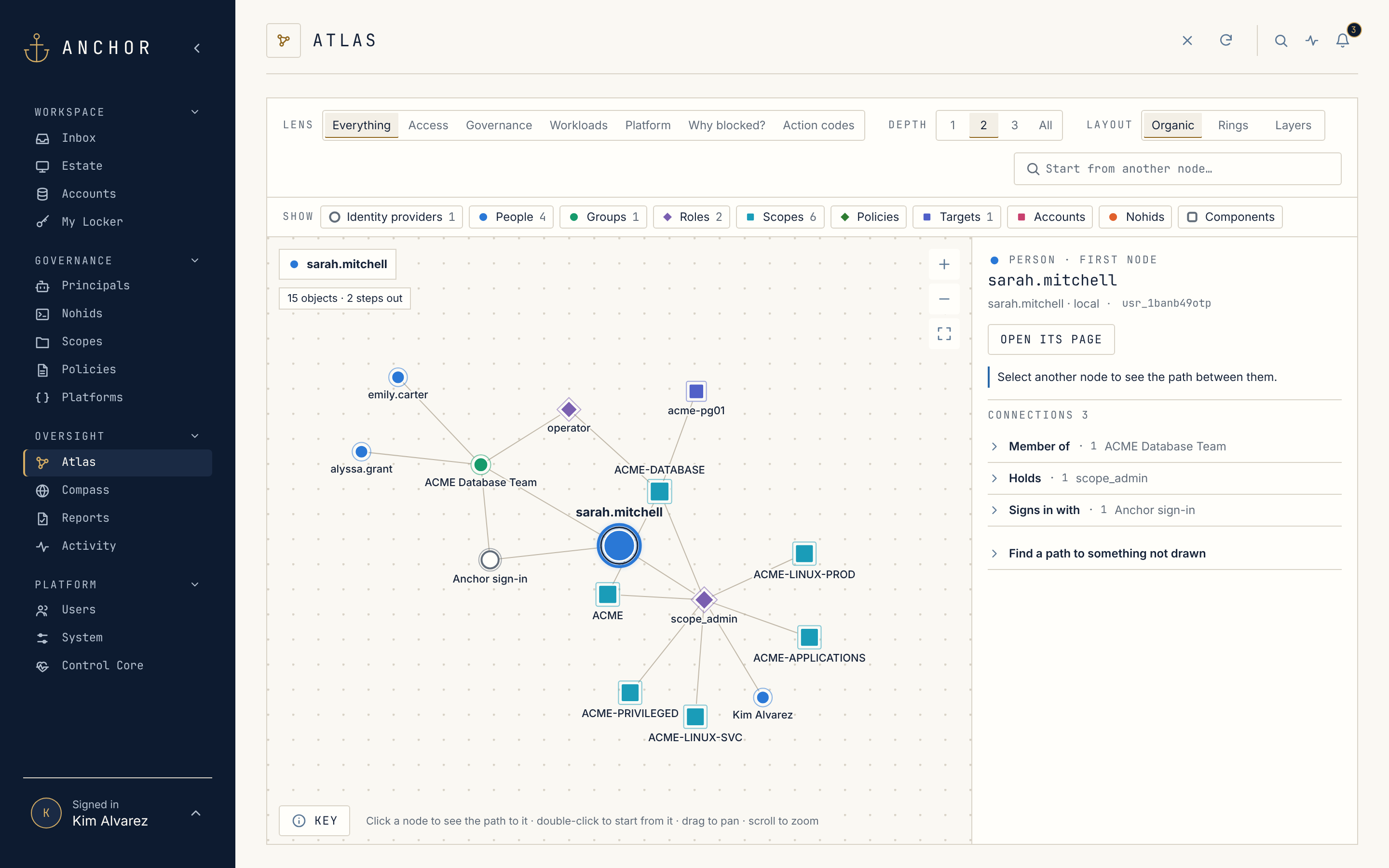
Atlas draws people, teams, roles, Scopes and accounts as one map from Anchor's records. Pick two points and it spells out the path between them, step by step.
Every Anchor service and every protected link between them, with its protocol, port and the certificate authority that guards it, as reported by the services themselves.
Every resource receives an identity. Every identity develops a history.
Every history creates intelligence. Every action remains governed. Every
outcome is proven.
In practice that means one record per privileged account, a history that
builds up with every check, change and session, a posture score drawn from
that history, rules that apply the same way to manual and scheduled work,
and evidence an auditor can follow from the action to its result.
Everyday OperationsManage With ClarityBring resources, accounts, and policy into one working view.+
Anchor connects the things your team manages with the policies and history around them. The aim is less tool-switching and a clearer understanding of the next action.
Repeatable OperationsAutomate Routine WorkPut repeatable credential work on a consistent path.+
Manual and scheduled operations share the same governed workflow. Automation fits into your operating model, with policy and evidence attached to the work.
Your EnvironmentKeep Your Deployment ChoiceRun on-premises or in your cloud infrastructure.+
Start with a single-host evaluation, then choose the placement that fits your team. Distributed on-premises and customer-managed cloud options keep your infrastructure requirements central.
Connected EvidenceUnderstand the OutcomeSee the history behind an action and what happened next.+
Actions, sessions, and findings retain their connection to the affected resources and accounts. That context helps operators investigate issues and supports security reviews.